

Have your say on the dry zone
Updated: 7 April 2025
You can have your say by filling out the survey, which will be open until 5pm Wednesday 23 April.
The survey has now closed.
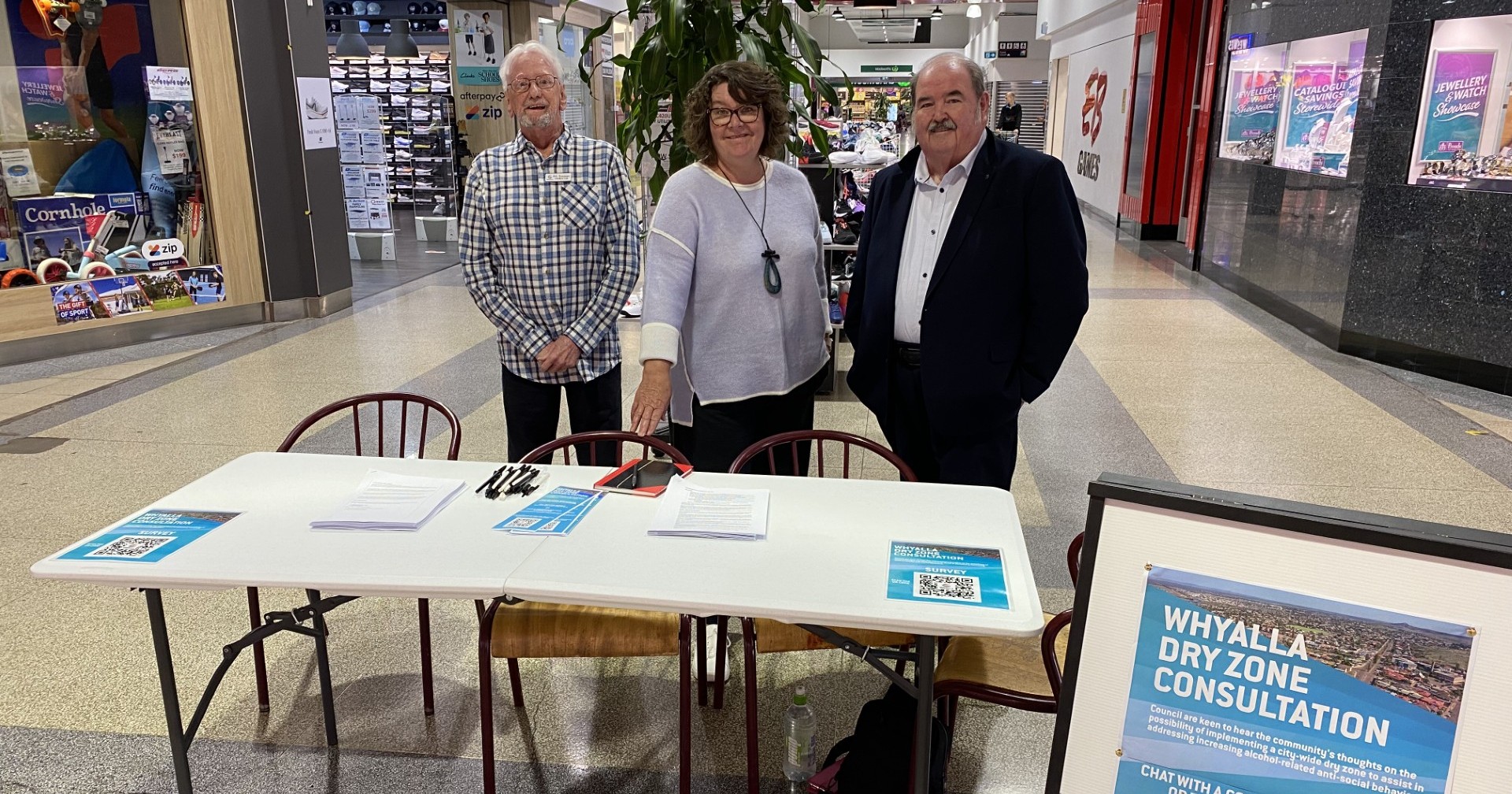
Council will be holding face-to-face sessions with councillors at various times, dates and locations to ensure we can reach the whole community.
Session dates:
- UPCOMING: Thursday 17 April: Westland Shopping Centre - Coles entrance 2pm - 6pm
- PASSED: Tuesday 25 March: Espresso Cafe 12pm - 2pm
- PASSED: Thursday 27 March: Westlands Shopping Centre Food Court 5pm - 7pm
- PASSED: Thursday 3 April: Westlands Shopping Centre Food Court 5pm - 7pm
- PASSED: Friday 4 April: Mint Cafe 9am - 11am
Media Release 7 April 2025
We’re now more than halfway through the dry zone consultation period, with just over two weeks remaining to have your say.
The survey is seeking residents’ feedback on the possibility of implementing a city-wide dry zone, which could be one of many measures to address mounting community concerns regarding alcohol-related anti-social behaviour.
Mayor Phill Stone emphasised the critical importance of as many community members as possible participating in the survey.
“This is perhaps the most important survey that council has ever undertaken, so we need a big community response which will help guide council’s direction,” Mayor Stone said.
“It is a simple, anonymous survey – your personal details are not required – with just four boxes to tick, indicating whether or not you support the introduction of a city-wide dry zone.
“I also reiterate that council has not made a decision either way. This could have impacts across the community, which is why we are asking for your opinion and why it’s so important that everyone has their say.
“If you are unsure which way to go, I urge you to go to council’s website and familiarise yourself with some detailed background information, or come to one of our face-to-face sessions.”
There are multiple ways to have your say:
- Take the online survey (survey is now closed)
- Grab a physical copy from our Civic Building on Grundel Street or the public library on Ekblom Street
- Head to our final face-to-face engagement session during the week of 14 April
- Date and location details will be provided by the end of this week
Council cannot solve this issue on its own. However, the area of the city covered by a dry zone is the one aspect within council’s control, which is why we are exploring this possibility.
On top of this, we will continue to work with multiple organisations, agencies and individuals on potential strategies to tackle the cause of the ongoing issues to achieve real improvements. This will need to include addressing housing issues; increased police resources; helping those who are at-risk to access support; and a host of other factors.
The survey will be open until 5pm Wednesday 23 April.
Media Release 19 February 2025
Key points
- Whyalla City Council is seeking residents’ feedback on the possibility of implementing a city-wide dry zone to address increasing alcohol-related, anti-social behaviour
- There is no silver bullet and council cannot solve this issue on its own, but the dry zone area is the one thing within council’s control that could assist in addressing the problem
- Council understands the community would like instant action, but it’s important any decision is fully informed, hence the need for community-wide engagement
- It will take a focused, multi-agency group to tackle the cause of the ongoing issues to achieve real improvements
- Council will continue to work with key organisations / agencies to implement initiatives within their control
Whyalla City Council has listened to mounting community concerns regarding increasing alcohol-related anti-social behaviour, now seeking residents’ feedback on the possibility of implementing a city-wide dry zone.
Council has received increasing complaints and requests to address behavioural issues around the Westland area and has been working with multiple organisations, agencies and individuals – including SAPOL, Westland management, Human Services, Member for Giles Eddie Hughes, nearby residents and others – on potential strategies to tackle these issues.
Mayor Phill Stone said while council could not solve these issues on its own, it would seek to do its part to address the problem.
“The one thing within our control is to determine the area of the city that is covered by a dry zone, so we will go out to the community soon to seek their feedback on a city-wide dry zone,” Mayor Stone said.
“We realise residents would like instant action, but there is no quick fix for this issue. It’s important we hear from the broader community first, as there could be numerous consequences from such a significant change, so any decision needs to be fully informed and considered by weighing up all the potential pros and cons.
“There are also legislated State Government timeframes necessary to make any major changes to a dry zone – including a four-month consultation period – so we will act as quickly as possible within these requirements.”
Mayor Stone said council had considered expanding the existing dry zone – rather than going city-wide – but it was deemed this would simply shift the problem.
“How do you fairly draw the dry-zone boundary at another street, knowing the current anti-social behaviours could simply be shifted to that area and make it someone else’s problem?” Mayor Stone asked.
“We have looked at various extension options – each with their pros and cons – and there was no ‘easy fix’ that seemed ideal, so the blanket dry zone was deemed the best option to take to the community for consideration.”
Mayor Stone highlighted that it would take more than just a change to the dry zone to solve the ongoing issues.
“There is no silver bullet, and a dry zone in itself will not solve the problem,” he said.
“It will take a focused, multi-agency group to tackle the cause of the ongoing issues to achieve real improvements. This will need to include addressing housing issues; increased police resources; helping those who are at-risk to access support; and a host of other factors.”
Council has started the community engagement process regarding a city-wide dry zone as soon, including face-to-face opportunities; online / physical surveys; and targeted stakeholder engagement. Click the button below to fill out the survey. Physical copies are also available at council's Civic Building on Grundel Street. Keep an eye on council’s website and the My Local Services app for face-to-face opportunities.
FAQ
1. What is a dry zone?
A 'dry area' is an alcohol-free zone. Under the Liquor Licensing Act 1997, the consumption of or possession of liquor (in open containers) is prohibited in this area. A person who consumes or has possession of opened liquor in a dry area is guilty of an offence, which carries a maximum penalty of $1250. The purpose of a dry area is to minimise any potential risk or negative impact on the amenity of a public area caused by anti-social behaviour associated with excessive alcohol consumption. Dry areas are signposted with 'No Alcohol' signs and enforced by SAPOL. The dry zone provides a useful ‘tool’ for SAPOL to confiscate liquor that is in the possession and/or being consumed by individuals within the dry zone area, particularly in public areas such as reserves; main shopping precincts; car parks; beaches and foreshores; and communities where drinking in public places is an indicator of complex social issues.
It is not an offence to have alcohol while genuinely passing through a dry area if:
* It's unopened and in the original container in which it was purchased from a licensed premises
* It's in the course of carrying on a business, such as a packaged liquor sales licensee delivering alcohol
* You live near a dry area and must pass through it to enter your home
* The alcohol is for religious purposes
Long-term dry areas are designed to work as part of a broader local-level strategy to reduce alcohol-related problems in the area.
2. What are the pros and cons of a city-wide dry zone?
Pros
- SAPOL can confiscate alcohol from individual(s) in any public places across the city, giving them the greatest scope to address alcohol-related issues more consistently across the city
- ‘Simplicity’ of blanket, city-wide arrangements – avoids confusion of ‘where can I / can’t I drink in public’
- Based on experiences in places such as Port Augusta, a city-wide implementation – combined with regular enforcement – could assist in reducing anti-social and criminal behaviour resulting from public drinking, while helping locals and visitors feel safer right across the city
- Prevents the issues from simply being shifted to another part of the city
Cons
- ‘Acceptable/responsible’ alcohol consumption cannot occur in public spaces across the city, unless a short-term liquor licence has been obtained
- Obtaining this licence requires lengthy timeframes – ruling out spur-of-the-moment gatherings involving alcohol – and has an associated fee
- Could result in increased alcohol consumption occurring within residential dwellings that may increase risk of over-crowding / domestic and family violence / increased anti-social behaviour and disturbances in residential streets
- The community is seeking immediate action on this issue. However, this option (as well as any significant changes to the existing dry zone) will take 5-6 months to implement, including extensive community consultation, so the prolonged period before implementation could exacerbate existing community angst
3. Why are you consulting on implementing a city-wide dry zone as opposed to simply increasing the existing dry zone area?
We have looked at various dry zone extension options, each with their pros and cons, and there was no ‘easy fix’ that seemed ideal. The concern is that any extension will result in the issues simply being shifted to another part of the city. The blanket dry zone across the entire city was therefore deemed the best option to take to the community for consideration.
4. Why can’t you do something straight away / why will it take so long?
- There is no quick fix for this issue
- It’s important we hear from the broader community first, as there could be numerous consequences from such a significant change, so any decision needs to be fully informed and considered by weighing up all the potential pros and cons.
- There are legislated State Government timeframes to make any major changes to a dry zone, including a four-month consultation period
5. How would a city-wide dry zone solve the problems we see in the Westland area?
It wouldn’t solve it, but it would give SAPOL powers to curb public drinking and any associated anti-social behaviour across the city. This still does not fix the root-cause issues that need to be addressed in a broader multi-agency approach, which council is already working on with local agencies.
We are mindful that some people may think that a dry zone will solve the issues. However, there could be various consequences arising from a decision to implement a city-wide dry zone that the community needs to consider (see ‘pros and cons’ question).
6. Would any change cost ratepayers and increase rates?
The main cost to ratepayers would be signage across the city, which would not have an impact on rates.
7. If it’s implemented, what if I forget about the dry zone and am caught drinking in public?
If a city-wide dry zone was adopted, there would be an implementation period of education / warning. There would also be increased signage installed across the city and regular reminders via council’s various channels.
8. How do you get a short-term liquor licence for a public space?
Anyone wanting to sell, supply and/or consume alcohol within a public place that is within a dry zone can apply to the Office of Liquor and Gambling for a Short-Term Liquor Licence. For example, if a family wanted to have a birthday party in a park or a concert / event was to be held in Civic Park, short-term liquor licences can be granted in advance for these purposes. This comes with prescribed timeframes to allow for processing / approval, so it needs to be applied for in advance and there is a cost to obtain such a licence. This would obviously be problematic for a spontaneous decision of a family to go to a local park to have a BBQ and consume alcohol.
9. Why can't police use existing laws – particularly loitering – to deal with the current issues, rather than needing a city-wide dry zone?
Loitering cannot be enforced to ‘move people on’ unless an individual(s) is restricting public access to an area or committing an offence. However, having an open alcohol container within a dry zone means they are committing an offence and police can decant their container at the scene and order them to move on as part of loitering laws. Once again, if this was implemented, it is not expected to fix the problem on its own, but be another tool to help police deal with one aspect as part of a broader range of initiatives. If at any time you believe you have witnessed an offence, it's important you report it direct to SAPOL on 131 444, or 000 in an emergency.
10. How do I have my say?
We will shortly offer a number of ways for the community to get involved in the debate and have their say. This will include face-to-face opportunities; online / physical surveys; and targeted stakeholder engagement. Information on how to get involved will be provided soon – keep an eye on council’s website and the My Local Services app.