

Find out more about the Capital Value rating system
Key points:
- Whyalla City Council is required by legislation to change the basis of its property rating from Site Value to Capital Value. This will be introduced from 1 July 2024
- The implementation has been delayed for as long as possible, with Whyalla one of the last three councils in the state still using Site Value
- Council does not raise any additional rate revenue out of the change – some property owners will pay lower rates, some will pay higher rates
- Capital Value is based on all aspects of the property – land, house, sheds etc, not just the location / land value – and is provided to Council by the Office of the Valuer-General
- There are multiple ways to have your say / find out more, including an online rates calculator, showing ratepayers the level of change they can expect
- Hardship options are available for anyone struggling to make their payments
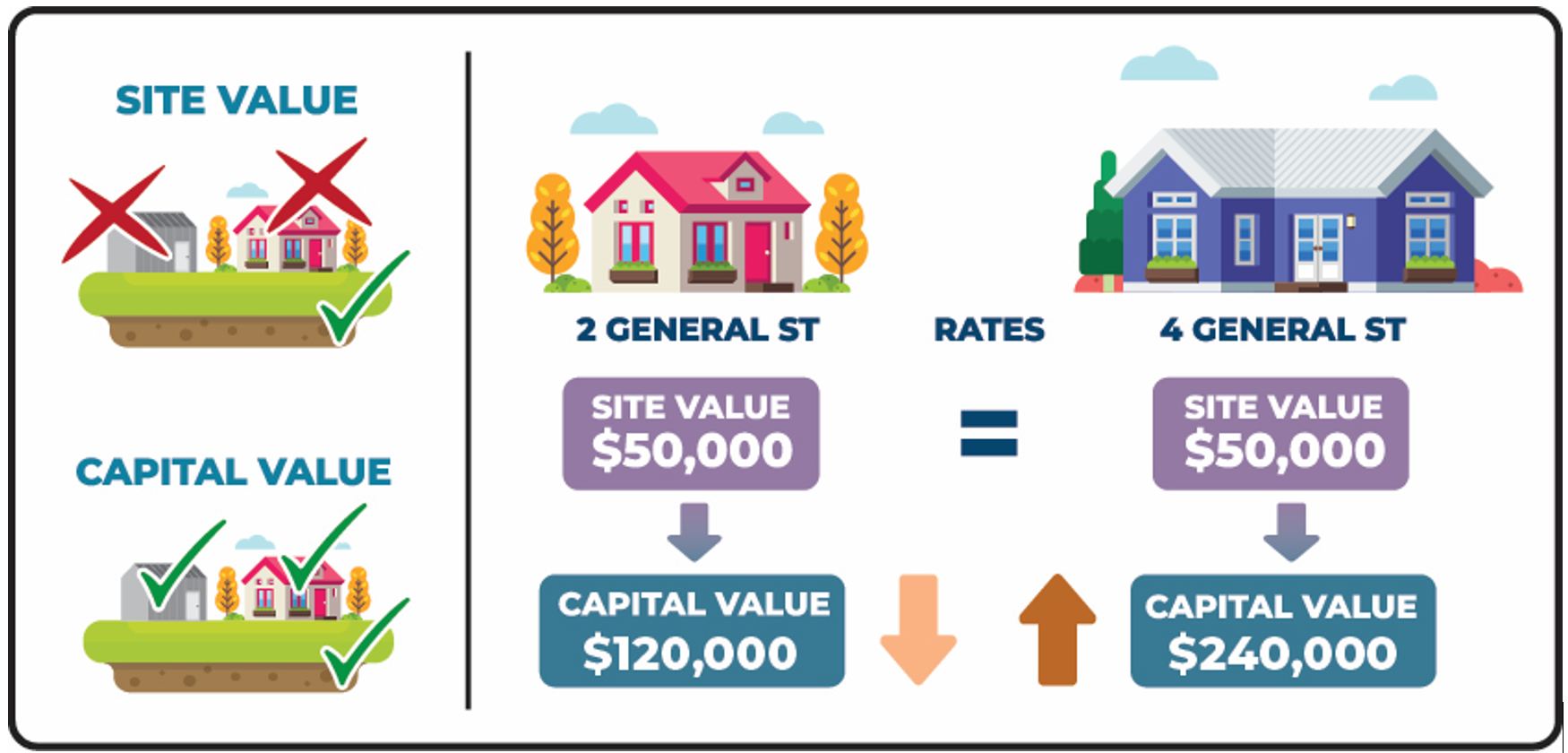
As referenced in rates notices over recent years, Whyalla City Council is required to change the basis of its property rating from Site Value to Capital Value, with this change to be introduced from 1 July 2024.
Council wants to ensure the community is well informed on the change and can voice their questions and concerns on aspects of the process, noting that the switch is compulsory.
Mayor Phill Stone said it was important for the community to realise that this was not a Council decision, but was required under state legislation.
“We have delayed the implementation of this change for as long as possible – we are one of the last three councils in the state still using Site Value,” Mayor Stone said.
“Council also does not raise any additional rate revenue out of this change, it simply redistributes the rates based on Capital Value. So while some property owners will pay higher rates due to their property having a higher capital value, other property owners will have a decrease in rates, as their property has a lower capital value.
“We are planning to minimise the increase that some property owners will experience by transitioning to the new system over four years – the maximum allowed under legislation – and using capping, with the maximum increase per year capped at 12 percent plus the general rate increase.”
Capital Value is based on all aspects of the property – land, house, sheds etc, not just the location / land value – and is provided to Council by the Office of the Valuer-General.
A common misconception is that the condition and upkeep of a property impacts the Capital Value, which is not the case. The Valuer-General is only concerned with the general features – such as construction type and size – and then compares this with sales of similar properties in similar locations.
View public consultation page here.
There will also be a public information evening on Tuesday 23 January at the Council Chamber on Grundel Street from 6pm, where ratepayers can raise any queries or concerns. Feedback can also be provided in-person at the 19 February Council meeting, or by emailing council@whyalla.sa.gov.au between 11 January and 19 February.
Mayor Stone said any ratepayers with properties moving to a higher rate allocation that had any concerns had several options.
“In the first instance, they can contact the Valuer-General on their website to appeal the determination of their Capital Value if they do not believe their property valuation is correct, which can be done prior to the changeover,” he said.
“Ratepayers can also contact Council to discuss hardship and payment plan options if they think they will struggle to pay the increased rates. We understand that a significant increase in Council rates will add to the current cost of living pressure many people are facing and we welcome the opportunity to discuss how we can assist ratepayers with payment plans to ease the burden. They will have plenty of time to make their case, with the changes not implemented until 1 July 2024.”
Rating Review – Frequently Asked Questions
Why have Council decided to start rating using Capital Values?
It is important for the community to realise that this was not a Council decision but is required under changes to state legislation.
The Statutes Amendment (Local Government Review) Act 2021 removed the ability for councils to raise rates using Site Values after the 2023/24 financial year.
Only six councils were impacted by this change, all of them on the Eyre Peninsula, with three already having made the change for 2023/24.
Why undertake consultation if the change is mandatory?
Under the Local Government Act 1999, Council is obliged to undertake a Rating Review when changing the basis of rating, which includes the requirement to undertake public consultation. This requirement was not removed, even though the ability to rate using Site Value is no longer available.
Council is consulting on more than just the move from Site Value to Capital Value. This includes the simplification of the system to focus on Land Use rather than Locality, and the increase in the Fixed Charge to reduce the impact of the change.
If Council start using Capital Values for rating, am I being punished with higher rates for maintaining my property well?
Capital Values are provided to Council by the Valuer General on an annual basis. The Valuer General does not visit each property on an annual basis to create these valuations.
Instead, the Valuer-General has information on the general features of each property, such as the construction type and size of any buildings and structures that are present. They then compare sales of similar properties in similar locations and apply a valuation increase to each property accordingly.
Therefore, making capital improvements to their property is the only way that ratepayers can impact on their valuation, the general upkeep of a property is not a factor that is considered.
Capital Value is always the same or higher than Site Value, so how will anyone’s rates go down?
Each year, Council calculates the total value of rates to be raised to fund services, with this amount expressed as a % increase from the total rates raised the year before.
Once this value is known, Council first raises the Fixed Charge, and then the remaining amount of rates to be raised is divided by the total value of rateable properties, to calculate a Rate in the Dollar (RID).
As Capital Values are higher that Site Values, the RID calculated using Capital Values will be much lower compared to when Site Value was used. This RID will be used to calculate rates and will result in some properties paying more rates and some less.
The rates calculator shows that I will pay more rates because Capping is being implemented, how is this fair?
Capping is being implemented to smooth the transition to the new rating system for those that will see a higher-than-average increase. This is considered to be the fairest overall outcome, but it does mean that those that don’t receive capping will temporarily pay more rates while we are making the transition.
There are essentially three groups that will be impacted slightly differently by capping.
· Properties that will receive an overall decrease due to the change in rating will see this decrease occur over a 4 year period.
· Properties that will receive a similar level of rates or a small increase will pay a higher level of rates in years 1 to 3.
· Properties that will receive a larger increase in rates will see this increase capped for up to 3 years, helping to smooth the transition.
The impact on properties not receiving capping will decrease in year 2 and 3 and will be gone by year 4.
The rates I will pay are higher than a similar valued property in Adelaide, why is this?
The average value of a property in Whyalla is lower than that in Adelaide, and the difference can be quite considerable depending on which Metropolitan council you are comparing with.
However, Council still needs to provide the same services that a Metropolitan council provides, and in some cases even more. The cost of providing these services is not cheaper in Whyalla just because our property values are lower, in fact it is often more expensive to provide services in regional areas.
This means that Council needs to raise the same value of rates that a comparable Metropolitan council would, but because our property values are lower, the Rate in the Dollar required to achieve this is higher, resulting in higher rates for similar valued properties.
A better measure is the average rates paid by each property, which for Whyalla is slightly below the state average.
I don’t agree with my Capital Value, what can I do about it?
Ratepayers can contact the Valuer-General on their website to appeal the determination of their Capital Value if they do not believe their property valuation is correct, which can be done prior to the changeover.