

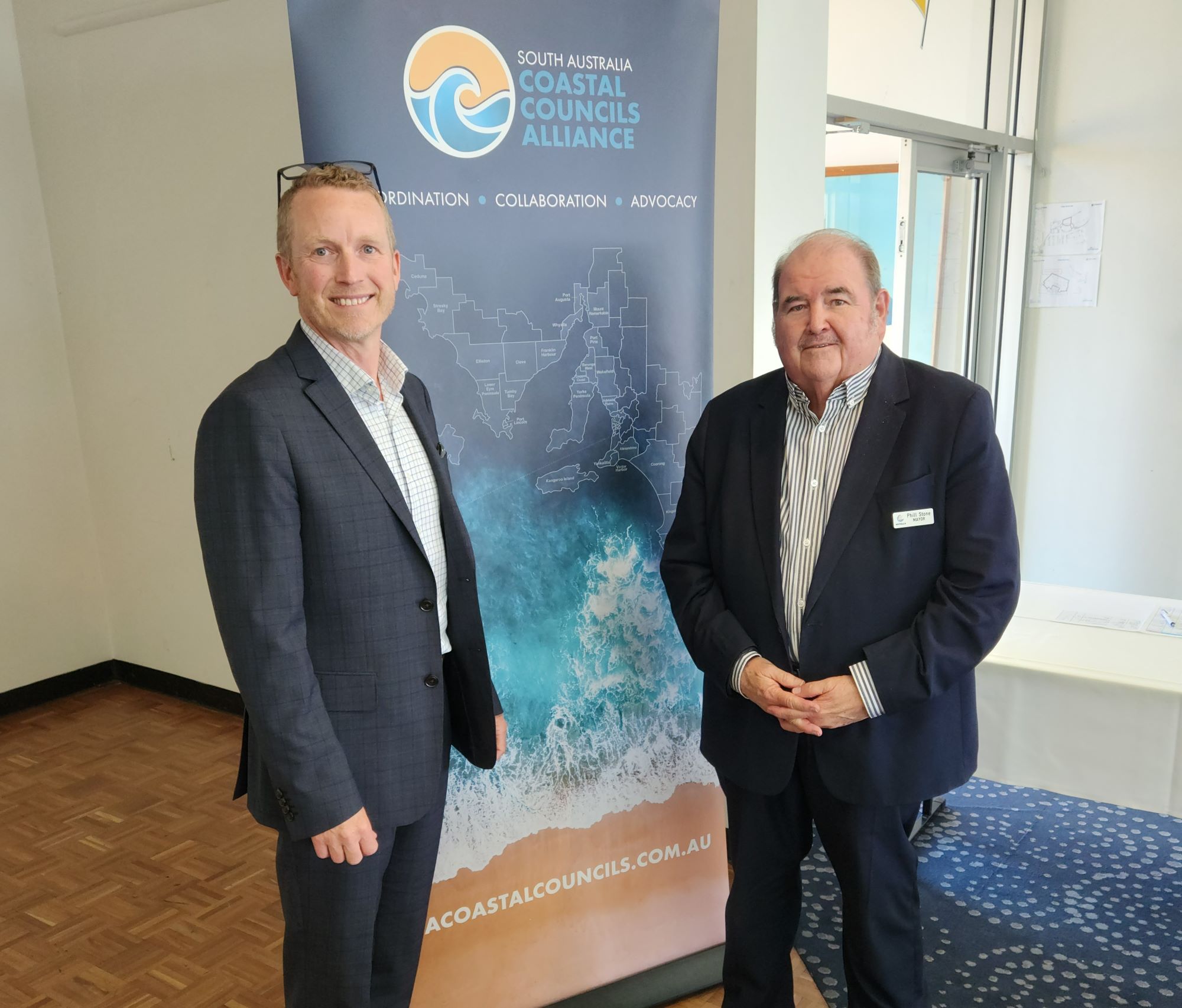
Mayor Phill Stone pictured with SA Coastal Councils Alliance executive officer Adam Gray.
Challenging times ahead for SA coastal councils
25 November 2024
Whyalla City Council’s ongoing program of sand replenishment, native vegetation plantings and the use of seagrass wrack to preserve the Whyalla Foreshore has been supported at the recent annual SA Coastal Councils Alliance Forum held in Adelaide.
The Alliance comprises around 25 local governments which have responsibilities to manage more than 5,000kms of SA coastline, while experiencing growing challenges of impacts from storm events, associated flooding and erosion, and an upward trend in costs and resources.
It provides an informed, coordinated advocacy voice for issues impacting on SA coastal councils, while importantly sharing information on coastal management facing councils across the State.
Forum attendees were from throughout the State, representing Local Government (elected members and staff), State and Commonwealth governments, the university sector, consultants and Landscape Boards.
Mayor Phill Stone, who is the Spencer Gulf Cities (Port Pirie, Port Augusta and Whyalla) Alliance representative, said that the various components of Whyalla’s beach retention program were highlighted by several expert speakers as essential for future beach and coastal preservation.
These included:
- The use of seagrass wrack, particularly incorporated into sand along seawalls, playing an important role in sustaining the beach and maritime environment
- The role of vegetation on beaches to maintain resilience when there are storms or high tides
- Recognising than man-made structures interfere with natural coastal sand movement with many examples along the SA coastline, which need solutions, not just blaming past practices and decisions, which were often made with the lack of today’s technical and environmental knowledge
Mayor Stone said he was well-aware of some community views critical of plantings on the beach and using seagrass, but “this is the way of the future if, through climate change, our beach comes under greater potential impact of weather events, sea rise and/or tidal movements.”
“As a council, we need to work towards an acceptable balance of what is essential preservation, and within these bounds, an attractive-as-possible beach.
“The current ongoing program is already showing its success in holding the sand, particularly from our, at times, ferocious southerlies.”
Mayor Stone added that several of the presentations were very “sobering” in regard to potential weather impacts. These included:
- Sea level rise predictions up to the year 2100 that cannot be ignored. Children born today have the potential to see 2100
- The annual sea level rise is currently around 4mm. Based on this figure, the rise by 2100 could be up to two to three metres
- Current modelling indicates that by 2050, temperatures could rise by two degrees, which was described as catastrophic
Other presentations, which were relevant to Whyalla included:
- Significant damage caused by bikes and four-wheel drives by people who consider it is their right to ride or drive wherever they wish
- Campers causing significant damage and impact on vegetation
- Councils working on programs to barrier off fragile access areas and relocate camping to protect the environment, but expecting resistance from irresponsible sectors
Mayor Stone said all coastal councils, including Whyalla, had the additional responsibility to provide, manage and maintain a wide range of coastal assets that not only benefitted residents and ratepayers, but a much wider visiting and tourist population.
“With the obvious rising costs and resources required to achieve the outcomes every council, including Whyalla, wishes to reach, ongoing preservation, maintenance and development of our local coastal facilities and environment will always be an ongoing, long-term commitment,” he said.
“While pressure on local governments to maintain coastlines and develop associated facilities which are expected by communities continue, greater State and Commonwealth funding will be required in conjunction with community understanding.”